






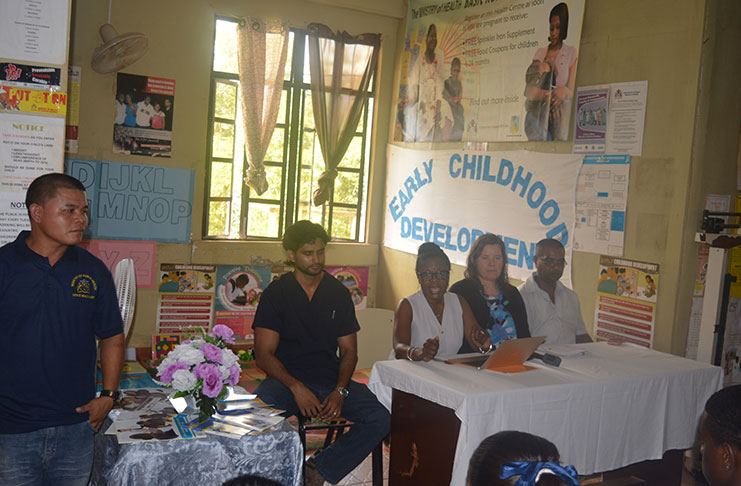
–as comprehensive adolescent-friendly health programme launched in Region Eight
By Lisa Hamilton
THE health of some of our teenagers living in Georgetown is not the same as the health of those living in Region Eight.
That’s according to Deputy Chief Medical Officer, Dr. Karen Gordon-Boyle, who made the observation on Thursday at the launching of the Ministry of Public Health’s Adolescent and Men-Friendly Health Programme in Mahdia, the seat of administration for Region Eight (Potaro-Siparuni).
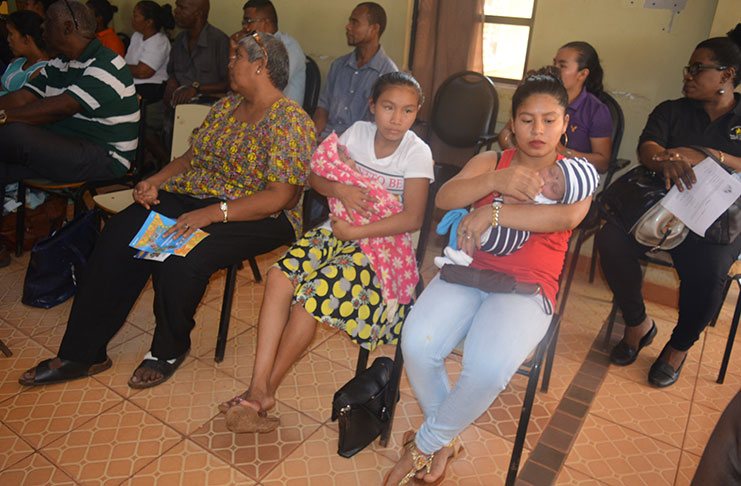
With the launch of the programme, the region, which is particularly prone to teenage pregnancy, now has access to Community Parenting Support Groups, Adolescent Antenatal Clinic Days, Adolescent Health and Wellness Days and a Men’s Health Clinic.
As Dr. Boyle reported during her presentation, Guyana’s teen pregnancy rate of 97 per every 1000 teenagers is the second highest in Latin America and the Caribbean, with a 40% occurrence being recorded in rural areas such as Regions One (Barima-Waini), Seven (Cuyuni-Mazaruni), Eight (Potaro-Siparuni) and Nine (Upper Takutu-Upper Essequibo) compared to 10% in urban areas.

According to Dr Boyle, statistics have shown that poverty, along with the remoteness of some hinterland communities, has a lot to do with these early teenage pregnancies in the aforementioned regions.
There is even data to prove that one in every five Amerindian teen becomes pregnant early, as does one in every four poor teen compared to one in every 10 born to rich households.
“So, we have to look at how we can even up the health of a teenager that’s born in the hinterland region and a teenager born in Region Four,” Dr Boyle said, adding that this can only be done by improving the quality of health services in the hinterland regions with the implementation of targeted training with an accent on adolescence.
It is felt that now that Region Eight has an Adolescent-Friendly Health Programme in place, the Mahdia Health Facility will become a safe haven of sorts for girls between the ages of 15-24, in that it will aid in their receiving not only helpful information, but the necessary resources they need to protect themselves.

NOT ONLY REGION 8
According to resident Government Medical Officer (GMO), Dr. Badyel Bakhsh, while teenage pregnancy is not limited to Region Eight, it is somewhat more prevalent there. And he attributes this trend to not just socio-cultural issues common to such communities, but the low level of awareness as well to the risks involved in what he terms “a vicious cycle”.
It is for this very reason, Dr Bakhsh said, that he is grateful to the collective effort of the media in getting the message across, and hopes that the broadcast media, in particular, will continue to air more health-related programmes.

Coming a close second to concerns about teenage pregnancy in the hinterland are the issues of incest and inter-generational sex, whereby young, poor girls engage in sexual activities and relations with older, wealthy men.
Dr. Boyle believes that while men have an important role to play in the denouncing of inappropriate relationship practices, they are more often than not the perpetrators of such activities.
It’s as if men hold the monopoly on deciding at what age one should begin having sex, she said, while the usually passive females have no choice but to submit to becoming engaged in early sexual activity.
And while these harmful social and cultural norms continue to expose young girls to Sexually Transmitted Diseases (STIs) and HIV Aids, Dr Boyle said, what these same men may not realise is that such activities can be detrimental to their own health as well.
“For men to be advocates and to work with us, so that we can help their families as a whole, they must start to value health for themselves,” Dr Boyle stressed.
To get to the stage where the Mahdia Health Centre is now men as well as adolescent-friendly, a total of 12 nurses, doctors and community members had to undergo rigorous training, including a four-day stint with the Ministry of Health’s Sexual Reproduction Coordinator, Ms Cilandell Glen.
Glen is of the opinion that the newly introduced services will be a long-term success with the help of the community members.
START WITH PARENTS
It is the firm belief of Dr. Boyle, however, that when parents become comfortable talking about sex amongst themselves as parents, and when encouraged to do so, it becomes easier for them to talk with their children about sex, a position the Ministry of Health greatly wants hinterland communities to arrive at.
“Everybody has sex, but they’re not talking about it; they’re not comfortable talking about it,” she said. “So teaching them and having forums where they can sit and talk about sex would help move some of the stigma and shyness, and make it become normal to talk about sex.”
Take the issue lightly, she said, and it would continue to contribute to the number of adolescents who resort to relying on their peers for what often times is misinformation.
Significantly contributing to making the programme possible was the United Nations Children’s Fund (UNICEF) which assisted in the area of capacity building of the community through education and donations.
UNICEF Resident Representative, Ms. Sylvie Fouet, in presenting a television and DVD Player to the programme for educational purposes, said: “Information is key for adolescent healthy lifestyle choices. First, they need to know; then they can make their own decisions.”
UNICEF also contributed Early Childhood Development toys, supplies and reading materials to the programme for the benefit of adolescent mothers.
These items, Ms Fouet said, would help to develop brain efficiency in children under and up to three; stimulate cognitive development in those under and up to six; and prepare adolescent mothers to take care of a child.
The Ministry of Public Health calls on the Ministry of Social Protection and other stakeholders to lend their support so that adolescent girls can be provided with the tools they need to protect themselves, receive an education and have the opportunity to be reintegrated into society.




