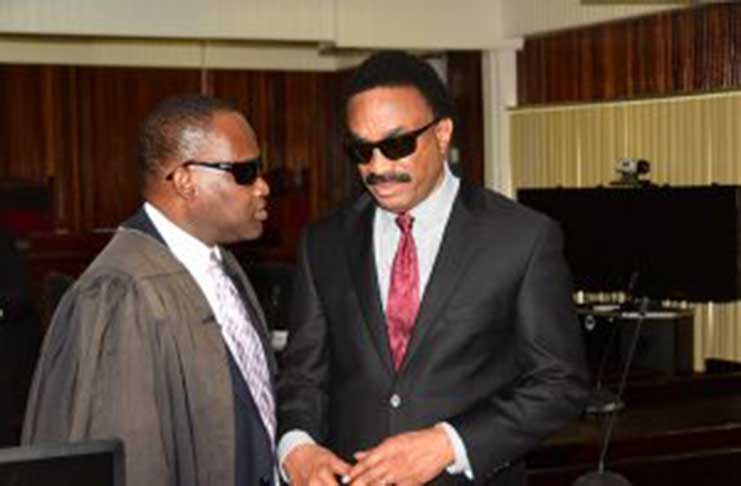
THE Court of Appeal on Thursday granted leave to Attorney General and Minister of Legal Affairs Basil Williams, and former Speaker of the National Assembly, Raphael Trotman to appeal to the Caribbean Court of Justice (CCJ) in the term limit case.
In February, the Court of Appeal by a two-one majority upheld the High Court ruling that the presidential term limit is unconstitutional and void. Now retired Chancellor of the Judiciary (ag) Carl Singh, and Justice BS Roy upheld the High Court ruling handed down by former Chief Justice (ag) Ian Chang’s, while Chief Justice (ag) nor Chancellor (ag) Yonette Cummings-Edwards had disagreed.
Immediately after the ruling was handed down both Williams and Trotman, indicated that they intended to appeal the CCJ within 30 days of the hearing, and expressed confidence that their arguments will stand strong at the CCJ. Williams had filed a notice of application in March, requesting leave to appeal to the CCJ pursuant to section 6 (c) and 7(a) of the CCJ Act, Act No.16 of 2004.
Meanwhile, the Court of Appeal also ordered that the Attorney General lodge with the Registrar of the Supreme Court the sum of $750,000 as Security for costs within 90 days from the aforementioned date and that Williams satisfy the requirements of Rule 10.6 (2) (b) of the amended CCJ rules by providing to the proper officer within a period not exceeding 90 days, a list of the documents which he proposed to be included in the record of appeal. On Thursday, Williams was represented by Solicitor-General Kim Kyte and Trotman by Attorney Roysdale Forde.
Just before the May 2015 General and Regional Elections, Cedric Richardson, a resident of Georgetown had challenged the amendments made to Article 90 of the Constitution that were enacted in 2000 following a bipartisan Constitutional Reform Process. Chang later ruled, among other things, that the presidential term limit was unconstitutional without the approval of the people through a referendum.
Richardson contended that the term limit infringes on Articles 1 and 9 of the Constitution wherein Article 1 states that “Guyana is an indivisible, secular, democratic, sovereign state in the course of transition from capitalism to socialism and shall be known as the Co-operative Republic of Guyana” and Article 9, states that “Sovereignty belongs to the people, who exercise it through their representatives and the democratic organs established by or under this Constitution.” It was as a result of the former Chief Justice’s ruling in July 2015 that the Attorney General and then Speaker of the National Assembly appealed against the ruling.
Meanwhile, Justice Cummings-Edwards in her dissenting judgment said Act #17 of 2000 did not require approval by referendum and noted that there is no dispute that it was validly passed and thus “I uphold the constitutional validity of Act No.17 of 2000.” She said too that insofar as Act No. 17 of 2000 purported to amend article 90 of the Constitution as former Chief Justice Chang ruled, the amendment was not unconstitutional but validly done.
Justice Cummings-Edwards cited Article 1 of the Constitution and questioned which aspects of the amendments have affected the country’s indivisible, secular and democratic nature, as well as sovereignty by the imposition of a term limit of two terms to the presidency.
“The answer is obvious from the ruling; Article 9 provides that sovereignty belongs to the people who exercise it through their representatives and democratic organs established by or under this Constitution. Clearly, the people of Guyana in whom sovereignty lies, no doubt exercised their sovereignty through their representatives, Parliament and local democratic organs. Richardson is being represented by attorney Shawn Allicock.