






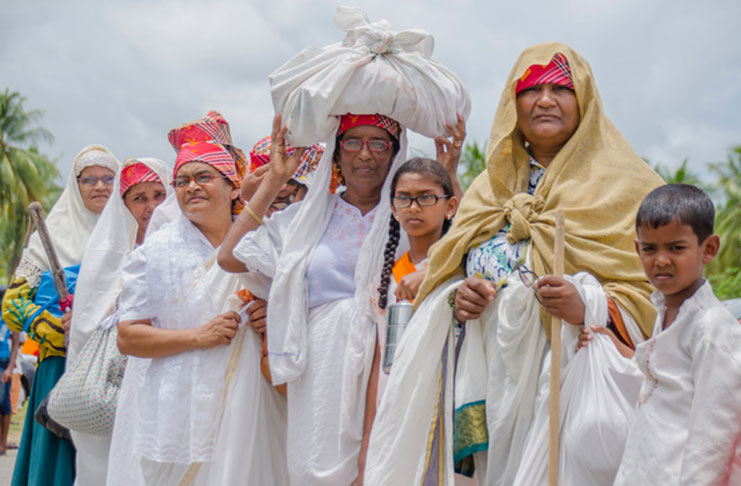
NOTING that Arrival Day is a time for togetherness, President David Granger says his administration is committed to continue working towards solidifying the Guyanese society by strengthening the strands of the country’s social strata.
At the same time the Head of State notes this year’s celebration of Indian Arrival Day as significant, since its observance coincides with the centenary of the end of Indian indentured immigration. The President was at the time delivering the feature address at Plantation Highbury, Berbice, on Friday morning at the annual ceremony in commemoration of the 179th anniversary of the arrival of Indians to Guyana.

“Arrival Day is a time for coming together. All have contributed to nation-building. All have to embrace a common destiny, one in which diversity is respected,” the President noted at the ceremony, which was attended by several government officials, including Prime Minister Moses Nagamootoo; Minister of Business, Dominic Gaskin and Minister of Communities, Ronald Bulkan. Regional Chairman, David Armogan and former Prime Minister Samuel Hinds also attended the event.
According to President Granger, “Guyanese should commemorate the chapter in the country’s history when its peoples arrived here. This date, this event, this place remind us of the value we all place both on our otherness and on our togetherness,” he said.
According to the President, Arrival Day commemorates the transformation of the country by the people who came and these include the Africans, Chinese, Indians and Portuguese together with the Amerindians, whom he noted have lived here from time immemorial.
“It transformed, also, the demography and the political economy of British Guiana,” the President said.

He told the gathering that Arrival Day is a celebration of cohesion. “It might have been an accident of history that our peoples were brought together in such a spectacular manner more than a century and a half ago”, he said. He noted however, that it was no accident that the citizens “had to work to weld the disparate peoples into a whole nation.”
He added that social cohesion was not an automatic condition of contemporaneousness, but rather it was administered, “on the anvil of struggle.” The President said that social cohesion had to be built, gradually and deliberately, from the commencement of indentured immigration in 1835 and this he noted was due to the efforts of all to accept and respect each other’s values and beliefs. It was not a small measure, he said.
According to the President, Arrival Day reminds the citizens that social cohesion cannot be taken for granted, noting that it relates to addressing the “most fundamental question” of how diverse peoples can live together in a multi-cultural society. “We should not hesitate to pay homage to each group that arrived”, he added.
The President reminded the gathering of Indian Arrival Day which is observed on 5th May, Portuguese Arrival Day which was celebrated on 3rd May, two days ago. Chinese Arrival Day was celebrated on 12th January of this year. African Emancipation Day will be observed on 1st August and Indigenous Heritage Month will be observed for all of September.

“We will continue to work towards strengthening society by strengthening the strands of our social tapestry,” he told members of the audience.
President Granger noted that Indian Arrival Day is commemorated traditionally at Highbury on the East Bank of the Berbice River as the main national ceremony. He said the Indian presence in Guyana is associated with the community, noting that it was at Highbury that the S.S. Whitby, with 128 Indians on board, docked on 5th May 1838, 179 years ago.
As regards this year’s celebrations, the President noted that its observance coincides with the centenary of the end of Indian indentured immigration. “Almost 240,000 Indians came to our country between 1838 and 1917, the year in which indentured immigration was abolished,” he informed the gathering, noting that more than 70 per cent stayed to make this country their home.
He said that Indians have made an indelible impact on this country’s cultural, economic and social life. He said the group brought with them a rich culture – including their beliefs, customs, dance, dress, festivals, food, music, rituals, speech and traditions. President Granger referred to Guyanese descendants of the original immigrants as more than mere “arrivants.”
He said that they are the heirs of a magnificent legacy – an extremely beautiful, blissful and most bountiful country that is now in transition to becoming a ‘green state.’
He said that the ‘green state’ , which he deemed a natural product of “this verdant and luxuriant environment” can flourish , noting that it will furnish a ‘good life’ for generations to come only by engendering a spirit of cohesion, one in which diversity is respected and celebrated.
Meanwhile, the event, organised by the Berbice Indian Cultural Committee, saw an unusually large gathering, when compared to recent years, when the numbers had dwindled. At yesterday’s gathering, hundreds journeyed to the sacred site, where the first batch of a hundred and twenty eight East Indians immigrants landed on May 5, 1838.
Many travelled by bus and other modes of transportation from the upper Corentyne Coast, while others came from western areas, such as Mahaica, and as far as Georgetown and had gathered for the 11:00hrs commencement, where sweetmeats and other Indian delicacies, and beverages were served.
The annual event was punctuated by Taan singing, invocational and celebratory dances by local groups and the Nrityageet dancers along with steel band medley and other cultural pieces. Earlier, their descendants reenacted the arrival of their ancestors who arrived 179 years ago onboard the Whitby to the hundreds including His Excellency President David Granger.




