






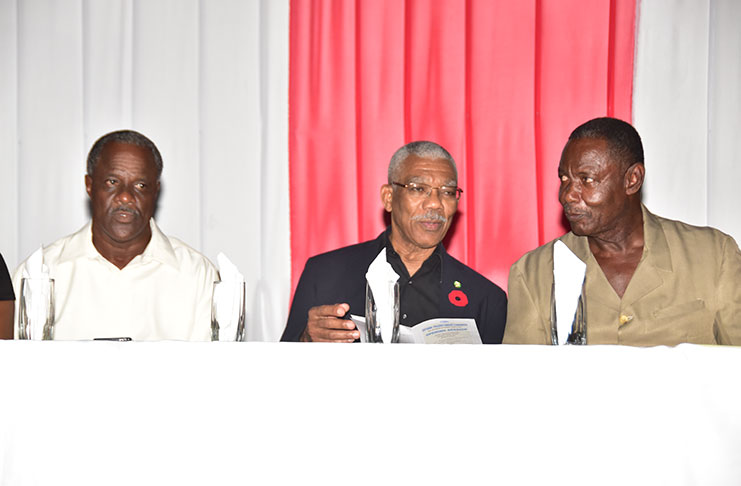
WITH less than 20 per cent of workers in Guyana being unionised, President David Granger on Thursday evening called for a remodelling of the trade union movement here. “In Guyana, fewer than 20 per cent of the workforce is unionised” he said, adding that a decline in union membership has affected credibility of unions in Guyana. The President was at the time speaking at the Guyana Trades Union Congress (GTUC) fourth Triennial

Delegates Conference which was held at the Critchlow Labour College. The conference is being held under the theme: “Labour policies, a prerequisite in creating a green economy.”
Tasked with delivering the feature address to the gathering of just over 100, President Granger opened his speech by providing historical information on the formation of then British Guyana Trades Union Council (BGTUC) which was established in 1941. The BGTUC, he said, would dissolve and be reconstituted a few times, before being renamed the Guyana Trades Union Congress (GTUC).
And despite these “ups and down,” he said that the union should be proud of its historical roots; one which has seen them at the forefront in the fight for the rights of workers. As time progressed, the President explained that the trade union movement became an instrument for mobilising the working class for social change. And this is exactly what has happened – change has taken place.
“Technology is making jobs redundant. Leading to job losses. Globalisation has led to jobless growth. When China sneezes, the bauxite and timber industries in Guyana catch a cold,” he pointed out.
In addition, he noted that the working class in Guyana continues to face great challenges and so are the unions. And in response to these challenges, the Head-of-State offered that, “We need a new model aimed at restoring workers’ confidence, and a new model that takes into account, changes in the job market. “We need a new model of trade unionism to build on the successes of the last 75 years and to prepare workers for the future” the President said, adding that change is needed to improve the quality of life for workers. He also suggested that attention needs to be placed on addressing the concerns of the working class, including those who are underemployed and unemployed, and that workers need to be educated and skilled if they are to function effectively.

President of the GTUC, Leslie Gonsalves, in delivering his address also acknowledged the existence of challenges, which he said unions stand a better chance to address, if they accept that they (the challenges) are there. “This occasion coincides with challenges we are presently facing. We stand a better chance of confronting challenges if we accept that they exist,” the GTUC President said.
However, he noted that in Guyana, the trade union movement continues to endure the pain of division, and this must be addressed to create a more conducive environment. He also pointed to the fact that foreign companies continue to exploit Guyanese workers, whom he believes, should enjoy the protection of the Government.
Gonsalves also weighed in on the view of labour unions being politically aligned, stating that “We must rid ourselves of the scourge of political intervention.” Delivering remarks too, was GTUC General Secretary, Lincoln Lewis, who read statements prepared by the Guyana Agricultural and General Workers Union (GAWU) and the National Association of Agricultural, Commercial and Industrial Employees (NAACIE),both of which fall under GTUC. President Granger also received a token from the GTUC, which was presented by the union’s (ag) treasurer, Kim Halley. The ceremony, which was punctuated by musical renditions from the Guyana Police Force (GPF) band, was also attended by Ministers of Government, foreign dignitaries, union executives and other members. Following the formal ceremony, a cocktail reception was held in the compound of the Critchlow Labour College.




