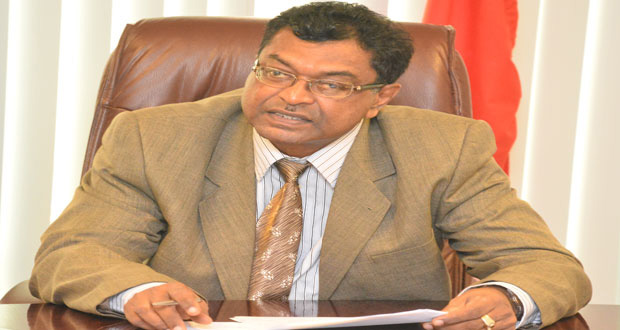
THE Ministry of Public Security will this year reconvene meetings of the Ministerial Task Force on Trafficking in Persons to avoid duplication of strategies among stakeholder agencies.Provision for the establishment and operation of this task force is provided for in the laws of Guyana, namely the Combating of Trafficking in Persons Act No. 2 of 2005.
A release from the subject ministry said the government of Guyana is thus duty- bound to ensure that this obligation is fulfilled. The functions of the task force will be carried out in accordance with Section 30 of the said Act.
The Task Force will be chaired by Public Security Minister Khemraj Ramjattan, who according to Sections 31 and 32 of the aforementioned Act, holds responsibility for the collection and dissemination of information on efforts to combat trafficking in persons and the training of law enforcement and immigration personnel, inter alia.
He will be joined by fellow ministers from the Ministry of Social Protection, the Attorney General’s Chambers and Ministry of Legal Affairs, and the Ministry of Indigenous People’s Affairs, along with the Minister of Foreign Affairs.
The task force will also include technical representatives from various ministries, other government agencies and non-governmental organisations, who will work together to carry out activities in the National Action Plan and Report to the Task Force’s ministerial representatives.
The crime of trafficking-in-persons is an international phenomenon which has been said to be the second largest criminal industry in the world.
The Ministry of Public Security has pledged to invest in initiatives geared at reducing the incidence of trafficking-in-persons in Guyana, with the aim of totally eradicating the scourge. One such major initiative will be the formulation of an action plan for the period 2016-2017.
The Ministry of Public Security is encouraging individuals to continue to report suspected cases of trafficking-in-persons to the hotline of the Ministry of Social Protection at 227-4083.
DRUG STRATEGY
The National Drug Strategy Master Plan (NDSMP) 2016-2020 will soon be released. This plan resulted from a review and modification of the NDSMP 2014-2018, triggered by the need to bring it in line with the most recent national and international dynamics of the drug problem.
The Government of Guyana is committed to ensuring the sustained safety and security of its citizens well into the future, against the drug problem.
In advancing this position, a strategic approach was adopted to remedy the problem. This plan therefore utilises a long-term, balanced approach between public health and public security. It addresses demand reduction, supply reduction, control measures, institutional strengthening and policy coordination, as well as international cooperation. It draws on the views of several ministries and non-governmental organisations (NGOs), as well as the results of outreach consultations conducted throughout the hinterland of Guyana when the 2014-2018 NDSMP was being prepared.
In essence, the NDSMP will guide the operational plans of all government departments and other bodies involved in the reduction of demand, supply control, and all other aspects of the national fight against drug abuse and its associated ills. The strategies expressed are based on the existing national situation, but also take into account several international treaties and agreements, including those proposed by regional, hemispheric and global agencies.
Durable collaborative efforts will be a prerequisite at all levels to effectively fight the world drug problem. The National Drug Strategy Master Plan 2016-2020 is a manifestation of that intent, as it involves the combined efforts of all stakeholders in proceeding continuously towards fulfilling a common responsibility.