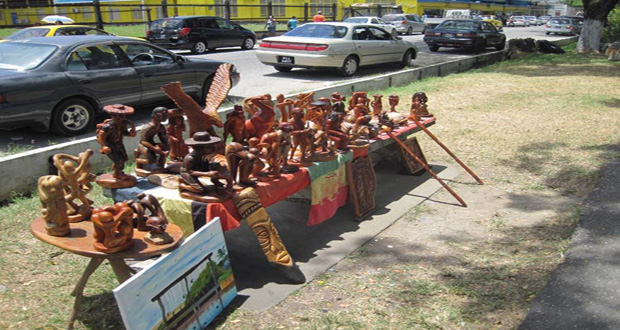
It was a time of change. Art had begun to impact once again on the minds of society, but this time there was a marked difference. Art was no longer controlled nor manipulated by the colonial masters. There was growing participation by the so termed working poor. It still is so now twenty years after. Changes in the entire society have created the need for change by practitioners of art. Money is now essential and plays a much more important role than previously. However, one day, speaking with my very talented artistic friend Neil Nunes, he had this to say…..”The Artist must be independent. He must make it clear that he is not seeking sympathy, not support. He is seeking financial returns for an artistic product offered for commerce.” He continued after a slight pause for rumination, “Independence is the only way to avoid manipulation. From the time they look at you; you don’t look like them; the rich and aspirant of richness don’t like the poor.”
I couldn’t have put it better. I have lived my life knowing and standing up to this challenge all my life. I can see the hypocrisy from a distance; but why complain, life is about being triumphant. That is all that matters. I became aware of the trials of so many outstanding Guyanese artists. I have known most of them and have been mentored by quite a few. I came into this artistic world with my eyes open for treachery. But was this an invention of the society? Was this situation created by the Guyanese in the street. Was it some deep compulsion to destroy his own culture and cultural icons. No it was not. He was and still is the pawn of the chains that were removed from his wrists and ankles and then wrapped around his mind. Bob Marley warns ‘EMANCIPATE YOURSELF FROM MENTAL SLAVERY,’ but people will tap their feet or dance to the melody. They will never assimilate the meaning of the words.
CREATIVE RELEVANCE
Art without recognition of indigenous cultural patterns does not advance development, but presents a façade that camouflages the reality. If art cannot motivate and uplift, then it has lost its creative relevance. In Guyana, there are many artists but only a few have impacted on the society, ‘thrown up by the society so to speak,’ and so can claim relevance and artistic prominence. Before the advent of these few men and women, the dominant culture was euro-centric. Those who claimed ‘art’ as their own were concerned with governance, the ‘colonial government’ so to speak. It was not until the latter half of the twentieth century that art was wrestled from those hands by the Dolphins, the Pilgrims and others of the new aspiring middle class; but later on the dominant culture began to shift from its euro-centric base and reflect the ‘creole’ or ‘people’s culture’, with emphasis on African oriented expressions of art. It all began after so called emancipation, when the shackles were removed from the feet and the wrists and wrapped around the mind.
SHACKLED MINDS
Emancipation and its consequences for Africans brought to the fore the divergent and contradictory self-interests of the two main opposing ethnic groups in the then British Guiana, namely the white colonial administration and plantocracy and the Africans. At this time in history, there were three recognized races, the white colonials, the Africans and the Amerindians. In this struggle for supremacy the physically freed Africans had numerical strength, while the colonials had the military power of state and colonial system on their side. Colonial power was used to restrict the Africans access to land and credit, to impose burdensome taxes and licenses to limit African economic activity. For example, the price of land in 1839 was $4.80c an acre for a minimum parcel of 100 acres, and by 1861, the price had been raised to $10.00 per acre. However legislation had been passed in 1852 to prevent group purchases of land, restricting the number of persons eligible to jointly purchase land to twenty 20. In 1856, this number was further reduced to 10 persons. Land acquisition therefore dried up during the second half of the 19th century. The lands previously purchased by freed captives became increasingly uneconomical due to sub-division, poor drainage and diminishing fertility. It took less than a generation after the so-called emancipation for the dream of African economic independence to become a nightmare.
CULTURAL DOMINATION
It was this tool of Cultural Domination that provided the groundwork for ethnic cleansing. Along with Race, Politics and Religion forced many Africans to leave the villages and migrate to the city and live in the Urban ghettoes. By 1860 petty crime and the introduction of prostitution became evident and prevalent. Articles used by Africans, such as corn, flour, salt beef, pickled pork, oatmeal, rice and candles were heavily taxed by import duties levied on them. Hence many Africans migrated to the gold fields; but although they may have escaped the political system, they could not escape the taxes. Today the same situation occurs. Migration has once again limited the cultural expression and the influx of foreign concepts used to suppress the creative expressions of the African mind. However, there are quite a few conscious practitioners of the creative arts who have held fast to indigenous culture and explore and express their cultural mores without fear or favour. I am one of those artists; we feel strongly adverse to sinister usage. My pen is therefore for hire to write about the culture of our times and its consequences.
By Ras Michael