Guyana’s economic performance has been lauded by several financial institutions, including the International Monetary Fund (IMF), World Bank and the Caribbean Development Bank (CDB). Since gaining office, via the country’s first free and fair elections, under the theme’ Time for Change; Time for rebuilding’ the People’s Progressive Party/ Civic (PPP/C) has steered the country’s economic fortunes to greater heights.
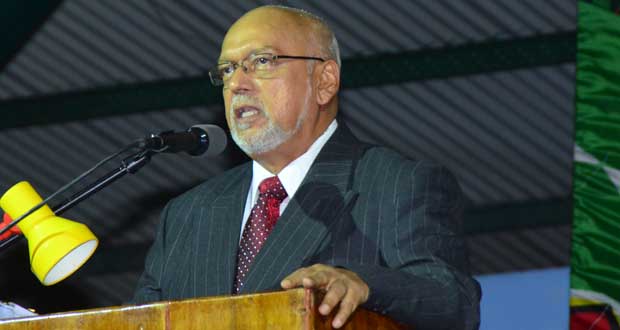
Looking back at the country’s dire economic straits under the PNC administration, President Donald Ramotar said the PPP knew it was bad while they were in opposition, but didn’t realise it was so bad.
The President said that the massive amount of debt was worse than many had imagined. With debt exceeding 700% of the country’s Gross Domestic Product and repayments to creditors at 94% of each dollar earned, the current administration had its work cut out for it, so to speak.
“We were in a really, really bad shape,” he stated.
On October 5, 1992, the PPP won the elections and that time was generally hailed as the return of democracy to Guyana, after 28 years of dictatorial rule under the PNC.
“The unfortunate thing about the debt that the PNC accumulated for this country was that there was nothing to show for the huge debt. We spoke about the broken infrastructure in every area, so there was nothing to show.”-President Ramotar
There was enormous enthusiasm by many following the change in government, the President noted during an interview with the National Communications Network yesterday, “Moreover, I would say that the reintroduction of democratic rule in the country was extremely significant,” the President asserted
Rooted in the PPP’s ethos is the feeling that democracy is very essential to social and economic development, President Ramotar explained. “Dr. (Cheddi) Jagan said very often that you cannot have sustained growth without social and economic development, without political democracy and for us it is not just a slogan, it is a deep belief.”
The country’s experience under the former PNC government proved this belief, he added, as well as the economic successes under his and prior administrations. The current government has deep faith in the “collective intelligence” of Guyanese people; President Ramotar said and always felt that by “freeing” the country from the clutches of dictatorship, energies would be released by all stakeholders to help turn the country around.
Describing the leadership of former President Cheddi Jagan as visionary, this, the Head of State said imbued, not only the PPP/C, but also the rest of the population, to work together to turn Guyana around and make it a better place.
Guyana has already repaid more than US$1 billion or Gy$200 billion to international financial institutions, in addition to obtaining debt relief, the President explained as he noted, ironically that there was not much to show for the monies borrowed by the previous PNC administration.
While acknowledging that Guyana was granted debt relief, he reiterated that Guyana paid out of its treasury.
“The unfortunate thing about the debt that the PNC accumulated for this country was that there was nothing to show for the huge debt. We spoke about the broken infrastructure in every area, so there was nothing to show,” he lamented, even as he wondered how much that money could have done to better the country.
Speaking of the first decade under the PPP/C; the president said that the fortunes were mixed. “The first five years saw a big spurt in economic development of our society, production was raised, the economy began to grow at a much more rapid rate, the government also engaged the international community, we demonstrated that this was a big difference, we practically had a revolution and people were seeing we were doing everything we could … we engaged international financial institutions on the issue of debt relief, because you know we had a debt of more than $200Billion.”
The 1997 elections was perhaps one of the best because of the processes, according to the President, but when the opposition staged their protests and evoked racist tendencies these set the country back, and hampered the momentum that was built up in the 1992 to 1997 period.
Following the 2001 elections, the process had to start again to continue replacing the broken down infrastructure. He said the PPP shifted the emphasis on spending on the masses, where it would affect people more.
“Up to 1992 the PNC Government spent more money on Ministry of Foreign Affairs than the whole social sector budget plus the Ministry of Agriculture put together. We shifted that, the biggest amount went to the social sector – to education in the first place, health secondly, housing began to get a spurt. Actually the last PNC government had closed down the ministry of housing we reestablished the ministry of housing to tackle the housing issue.. So we started to put more emphasis on areas where they would have had a bigger impact on the masses… instead of paying a rent they were paying for their own homes and they get the security of living in their own home.”
He spoke of the strides made in education and health especially where he said there has been a revolution in the latter area, even as he recalled the health situation pre – 1992. .Life expectancy was low as HIV/ AIDS was wreaking havoc in society. Today life expectancy is now age 70.
Speaking of the following 12 years, he said the economy became stronger, debt reduced and the government began to invest more in its people and in services for the people.
He cited the nightmare situation prior to the construction of the Berbice River Bridge which allows one to cross the river in about three minutes. There is specialized eye care offered at the ophthalmology hospital, the housing situation became more accelerated, under every PPP/C government as people now in their 20s own a home.
“I feel so proud that I have been part of this whole process of government at the time when those things took place,” he stated.
Listing some of the other major developments – national stadium, synthetic track, aquatic centre, conference centre, new hotels, he stated that all of these have helped to push the country forward.
Guyana has had eight years of economic growth and is projected to grow its GDP by another 5% by the end of this year.
(GINA)