Considerable resources have been expended to retool, modernise GFS
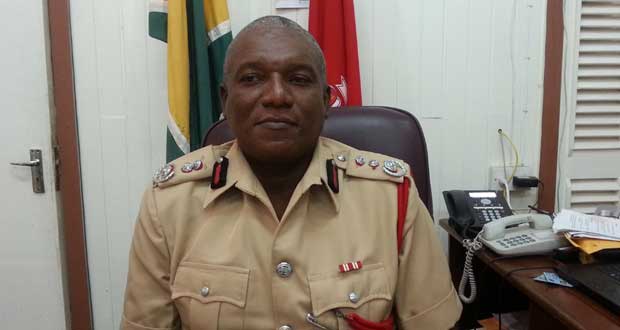
CHIEF Fire Officer, Marlon Gentle, has revealed that from 2009 to now, considerable resources have been invested in the Guyana Fire Service (GFS) to re-tool and modernise its fleet and equipment.
Accordingly, fire-fighting vehicles and auxiliary equipment, such as hoses and rescue equipment, have been purchased, and five new fire stations have been opened at the following locations: Diamond, Onverwagt, Rose Hall Town, Mahaica and Bartica.
Hinterland Fire Protection Plan
Gentle said that in its 57-year history, the GFS now has more range in rolling out its services in the communities, and has embarked on the Hinterland Fire Protection Plan, which was launched in 2012.
He said that the plan has been successful, with Port Kaituma, Mabaruma, Mahdia, Lethem and Kwakwani — five of the more populated areas in the interior — having since benefited from establishment of Auxiliary Fire Stations and receiving equipment that would enable them to respond to fires and give the respective communities a first response.
Gentle said the GFS went into those communities and, so far, 60 persons therefrom have been trained and are operating as auxiliary members of the Guyana Fire Service, receiving a stipend to provide their services.
Gentle said the Auxiliary Fire Stations all have equipment ranging from all-terrain type fire fighting vehicles at Lethem, Mahdia and Kwakwani to two fire-fighting trailers being installed one each at Port Kaituma and Mabaruma.
Gentle pointed out that the Guyana Fire Service has 46 different types of fire-fighting vehicles, among which are bowsers, tankers, and conventional fire-fighting vehicles, most of which were acquired in 2009; but the GFS has been gifted several vehicles from the Chinese which are capable of responding to fires and rescue emergencies.
Gentle said, “I think we have long gone past that era when we had one or two fire tenders in one division. We have seen marked development in housing and types of construction going on, and we have been looking at these things and upgrading in trying to bring ourselves to that level.
‘We have just tested ourselves at the high-rise buildings and we are comfortable that the high-rise vehicle that we have meets the capability necessary for such,” he said.
Training
The Chief Fire Officer pointed out that the GFS is not a sleeping organisation. As such, he said, training is an ongoing exercise at all levels.
He added that, presently, the GFS is in process of doing massive recruitment, attracting persons to fill vacancies as fire fighters.
Gentle pointed out that the GFS has increased its manpower by 84 ranks, taking its full strength to 511 personnel; and training will soon commence for an additional batch of 120 ranks, who have been shortlisted and will go through the induction process to ensure their suitability for the job before they commence training by August this year; “…and that will bring the GFS to full manpower requirements,” he disclosed.
He said all stations would be fully manned, and the GFS would be staffed by ably-qualified officers; and added that the GFS has been training personnel all the time, and some of its staff who have been trained both locally and overseas have been training local staff, hence expertise has been cascading down to all levels of ranks in the GFS.
He noted that fire-fighters have a multiplicity of skills, are specialised, and have well-rounded personalities, since their operations demand such.
Giving an example, he said there are fire services at the two major airports, and the ranks there possess the skills and expertise necessary to respond to emergencies involving aircraft.
Gentle said the GFS also has responsibility to protect the harbours, because if a vessel is on fire, the GFS has to respond appropriately, although it currently does not have response capability in terms of a fire-fighting vessel. Nevertheless, he said, the GFS would respond to such an emergency by using contingency vessels, in collaboration with the Guyana Defence Force (GDF) Coast Guard and the Maritime Administration Department (MARAD).
He said the Guyana Fire Service is hoping to acquire its own fire-fighting vessel, but in the meantime is deploying unorthodox methods in its response by utilising vessels from other agencies.
(By Michel Outridge)