






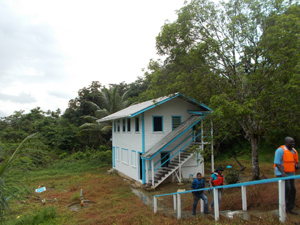
Villagers in the community of Kanuballi in Region One (Barima/Waini) will soon be getting electricity provided by two large isolated solar photo-voltaic (PV) systems under the “hinterland energy access” project which is being funded by the United Nations Development Program (UNDP) to the tune of $9.8M.
 A total of 1820 watts of electrical power will soon be provided to the community under a Government of Guyana and UNDP project entitled “Energy Access at the Community Level for Millennium Development Goals (MDG) Achievement in Hinterland Areas”.
Tenders are currently being invited from qualified contractors with a deadline date of September 16, and the contract will be awarded to the successful bidder by September 23, a reliable source disclosed.
The project implementation will be managed by the Hinterland Electrification Unit (HEU) of the Office of the Prime Minister (OPM) with technical support from the Guyana Energy Agency (GEA), and logistical support from the Ministry of Amerindian Affairs.
A source close to the project said that the Kanuballi project is one of many planned under the energy access in hinterland areas project.
“Access to modern energy services by these communities is essential to Guyana’s ongoing efforts to meet the MDGs, as it has been established that improved energy services are necessary to achieving all of the MDGs,” the source disclosed.
The overall aim of this GOG/UNDP project is to provide energy access at the community level to all hinterland communities by 2015.
With respect to Kanuballi, the source said that in the last quarter of 2012, an energy needs survey was conducted in 35 villages in Regions 1 (Barima/Waini) and Region7 (Cuyuni/Mazaruni) with the aim of developing a pilot project.
The final report of the survey showed that Kanuballi had the lowest installed electricity capacity per person of all the communities surveyed. This information was used as the basis for selecting Kanuballi, out of the 35 villages surveyed, as the site for the pilot project.
At Kanuballi the contractor will install on the school a 1040W isolated solar photo-voltaic (PV) system along with eight 15W compact fluorescent lamps for lighting, and two duplex power outlets for powering audio and video equipment (TV, DVD player and radio) to aid learning.
This solar power panel will be used to provide power to an energy-efficient, 8 cubic-feet solar freezer for the storage of meat and vegetables for the school feeding programme.
The other solar panel with an output of 780W will be installed at the health clinic along with eight 15W compact fluorescent lamps for lighting, and two duplex power outlets for powering a refrigerator for the storage of vaccines and other medications, and for powering other devices when necessary.
Chief Executive Officer (CEO) of the HEU, Mr. Horace Williams said that a team from the HEU will also train five persons (including at least two women) from the village and provide them with a tool kit to maintain the solar PV systems.
The project also includes the construction of three energy-efficient, wood-burning stoves to be used for cooking meals for the school feeding programme.
Residents will be shown how to construct these stoves and encouraged to use them.
The project will also provide at least five solar cookers to the community to complement the wood-burning stoves at the school and for use at the health clinic for boiling water,etc.
The implementation of the project at Kanuballi is expected to provide valuable lessons for executing similar community-level energy access projects in other hinterland communities in the future, Mr. Williams said.




