






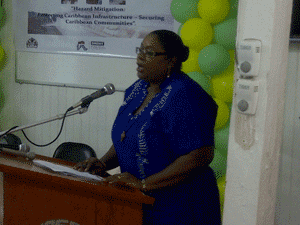
 On Education Minister Priya Manickchand’s behalf, the gathering was addressed by Ms. Melcita Bovell, Technical Adviser to the Minister of Education and Head of School Boards.
Present were notables in Professor Arnoldo Ventura of the Micro University College; Professor Emeritus Winston Mellowes of the University of the West Indies; Dr. Julianna Alexander of the University of the West Indies; Mr. Navin Chandrapal of the Office of the President; Mrs. Jennifer Cumberbatch, Director of NCERD; Mrs. Inge Nathoo, Secretary General of the Guyana National Commission for UNESCO; and Mrs. Petal Jetoo, National Science Coordinator, among others.
The opening ceremony was graced with musical renditions from the Dolphin Secondary School Steel Orchestra, which played a variety of local, Caribbean Guyanese and gospel music, and captured the minds of most present.
The programme was opened with a prayer by Mrs. Wendella Roberts, Senior Subject Specialist (Science), and there followed a brief but interesting welcome by Mrs. Jennifer Cumberbatch; after which there were brief remarks from Mrs. Nathoo and Messrs. Chandrapal, Mellowes and Ventura before the feature address was given by Ms. Melcita Bovell.
Bringing greetings to all from the Honourable Education Minister Ms Priya Manickchand, who had been unable to attend Monday’s opening of the workshop, Bovell observed how wonderful it was to be part of the workshop, as she noted that the mandate was intimidating because it rested on the shoulders of science teachers of Guyana and the Caribbean, and lay in the future of Guyana and the Caribbean. She added that science would help our world to be sustained, and to evolve and develop.
Bovell said that if Guyana or the Caribbean were to develop, science, mathematics and technology would have to drive such development. She said her colleagues who sat at the head table were therefore responsible for all to stand.
“It is a long time that we are trying to (impart knowledge of and interest in) science and mathematics in our schools, and I am not too sure how far we have gone (in this endeavour); but I do know that efforts within the last few years to get these workshops off the ground cost Guyana and the Caribbean, and we are getting there in a great big plus,” she said.
Noting that these two subjects are often deemed difficult, and are done by a select few who are chosen to do them, Ms Bovell reminisced on her days at school when a majority of boys and a few girls sat those subjects, she being one of them.
She noted that times have changed today, and more females are in our science and mathematics classes, and are teaching the subjects as well.
Bovell noted that what the Caribbean is faced with is how to have higher levels of science students graduating. She opined that it comes down to how teachers deliver to the students. She stressed the important of getting students to understand that science is not just something learnt but something lived.
Making the point that teachers do not do science with the students, but cause the students to live science, she challenged teachers to have the students step out of their beds and homes and experience that science is real, and that it must be (studied and improved upon) in order to have our world progress.
She mentioned making young children understand that their actions or inactions would be responsible for climate change, and she challenged her audience to get children involved in the activities that would promote the sciences and technologies of the day.
She said teachers would have to assist students inculcate proper waste disposal practices, so that they can eventually manage to properly dispose of waste in order to avoid flooding and other climate change phenomena; and she charged her audience to disseminate the information they were receiving.
The need to manage our greenery, and food security and other topics were then brought up for questioning, and there was a call for all to be aware and alert.
Environmental care and science and technology were other challenges looked at. Noting that children once brought everything they found outside to the classroom for preserving, Ms Bovell said children must today learn about the consequences and benefits of preserving the greenery outside.
She noted that science has got to be taken outside of the classroom, and opined that large, expensive laboratories have got to understand that the largest and most expensive laboratory is outside the classroom, and it will help our children to live and appreciate science.
The workshop got into session with three presentations by Professors Mellowes and Ventura, and by Dr. Alexander in “Hazard Mitigation”, “Understanding Science to Improve Teaching and Learning”, and “Introduction to Curriculum Development Process” respectively.
The opening ceremony was chaired by Professor Lloyd Kunar.
Teachers will, today, have the opportunity to visit the Mangrove Restoration Project in Guyana, and will participate in sessions presided over by local and overseas facilitators.
The workshop will conclude today after an evaluation session, and certificates will be presented to participants.




