





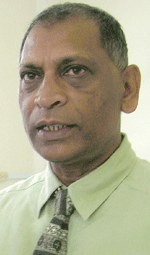
– Minister Ramsammy
GUYANA will be setting the stage and taking the leadership role within the CARICOM Region to create legislation for beginning the production of bio-fuel for local and international purposes.  It would be another step forward in ensuring that this country attains its goal of being on the world’s frontier in this regard, Agriculture Minster, Dr. Leslie Ramsammy said on Thursday.
During an interview with the Guyana Chronicle, he said that would be another critical step, as it relates to this country developing a bio-fuel industry and works are already being vigorously pursued.
Ramsammy said Guyana will be closely monitoring the production process to ensure that producers and manufacturers are blending the fuels after procurement.
“If we are going to do this, legislations are needed, because we have to look at what we going to do with bio-ethanol. We have local uses for it here and can also export it. One way of looking at it is we can go towards a blend of fuels for vehicles,” he said.
Ramsammy pointed out that, already, developed countries have been progressing through legislation and will see Guyana following closely to be on the front burner of the international market.
“Many countries have already done so but mainly the developed countries. So the United States has various blends, they can’t use pure petroleum. We have to use a blend, one particular blend is called E10. This is what comes out of gas stations when you buy it. It has 10 percent ethanol and in some countries it is higher. But that is why it is legislated. You have to have a blend and vary the blend to fit the usage in your countries,” he explained.
Ramsammy said that bio-fuel production is something that Guyana has been working on for time now and noted that the recent move by local and international companies to make an input into this development came about after the 2007 Caribbean Conference on Bio-fuels.
“This is a topic that should see consultations starting from now and we are moving towards a bio-fuel goal and so Ansa McAl engagement right now is feasibility. They are looking at whether they want to get involved in a pursuit that Guyana started a long time,” he stated.
Take time
Ramsammy acknowledged that the establishment of this new bio-fuel legislation will take time before it can be fully implemented. However, it is a task that will be pursued in a timely manner since it is necessary and goes in accordance with the legal procedures.
“We have to look at this legislation so that when people procure gasolene, they have to blend it before they sell it. It will also mean that our legislation will take a longer time because they have to adapt to the use of blended fuel rather just pure ethanol,” he posited.
Minister Ramsammy maintained that agriculture is not about feeding the country’s people alone, but also diversifying it so it includes the production of non-food commodities.
He said agriculture in Guyana should not be about subsistence living. It is about creating wealth and, in this regard, the bio-energy field represents a wealth-creating trajectory.
That is one of the main reasons the country is headed in this direction, as Guyana is a country rich in natural resources and, as such, many opportunities exist for large-scale cultivation.
“This is why Ansa McAl and other interested partners are talking about it. There are many people calling and coming and there’s a group from India and there’s a group from Malaysia. They are all coming to talk about this but it is all at the exploration stage,” he acknowledged.
According to Ramsammy, Guyana’s announcement a few years ago at the International Caribbean Conference on Bio-fuel, paved the way for the attention that has been gained internationally.
He said this not only allows the country to attract meaningful players at the international level, but also gives the opportunity, in terms of laws and regulations, by setting the trend in the Caribbean.
“Guyana would be out front if we address legislation of blending of fuel. Guyana will set the stage within CARICOM for these things,” Ramsammy maintained.
He said it would also give small farmers the chance to produce both bio- ethanol and bio-diesel that can be used for local activities and export.
Several sites
Ramsammy said Guyana has several sites for such production and he cited Wauna, in the North West District; the intermediate savannahs in the Rupununi and the Canje Basin in Berbice; all where both sugar cane and oil palm can be grown.
Therefore, Guyana can be a meaningful player in the production of both bio-ethanol and bio-diesel that could be used locally and it could be mandated that vehicles use blends of those things or sell them to other countries, he contended.
Additionally, Ramsammy said Guyana was the recipient of a technical cooperation grant of over US$900,000 after it had voiced its interest in the production of bio-fuel at the last Caribbean Conference in 2007.
“They were speaking about bio-energy for the Caribbean and it was Guyana that, right away, pursued it and resulted in the IDB (Inter-American Development Bank), giving us a technical cooperation grant of over US$900, 000 and so several things are happening now,” he recalled.
Ramsammy said, already, consultancy has begun and strategies are being implemented to identify what Guyana needs to be done to deliver in this regard.
He said the IDB has indicated its commitment to continuously support Guyana during this development and establishment process of the country’s bio-fuel industry.





